
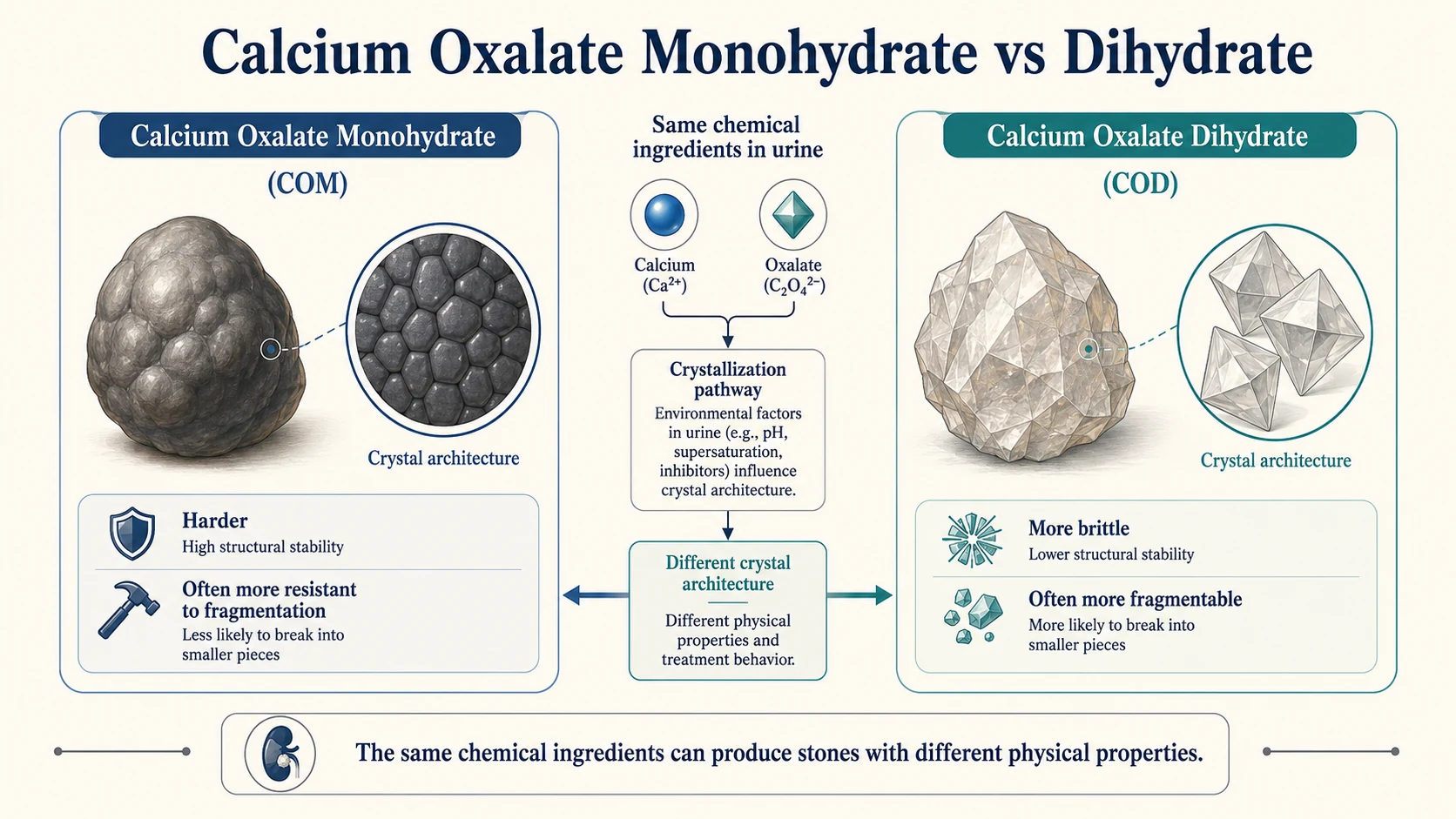
The same mineral can take different forms
Calcium oxalate monohydrate and dihydrate differ in their crystal structure. These differences help explain why stones do not all fragment in the same way. The book’s crystal illustration makes this concept visible; it cannot tell us which crystal is inside your kidney. A laboratory stone result is more informative than judging appearance.
Density is one piece of the assessment
A CT report may describe density in Hounsfield units. That measurement can help estimate how a stone may respond to shockwaves, but it is not a complete prediction. Size, position, the distance from the skin and the route fragments must travel also matter. We review the actual images and the report rather than making a decision from a single number.
What this means for an office visit
ESWL focuses shockwaves from outside the body onto a suitable stone. Our evaluation connects the stone’s properties with your anatomy, symptoms and health. Some stones need more than one session, and fragmentation must be followed by clearance of fragments. Bring prior imaging and analysis so we can explain your individual plan in ordinary language.
Your next steps
- Bring the CT images as well as the written report, if available.
- Ask what characteristics support ESWL for your stone.
- Ask how treatment progress and fragment clearance will be checked.
Keep exploring
Book and sources
Adapted from Stones Unlocked by David Shusterman, MD. Treatment and prevention are individualized.