
Choose the study for the question
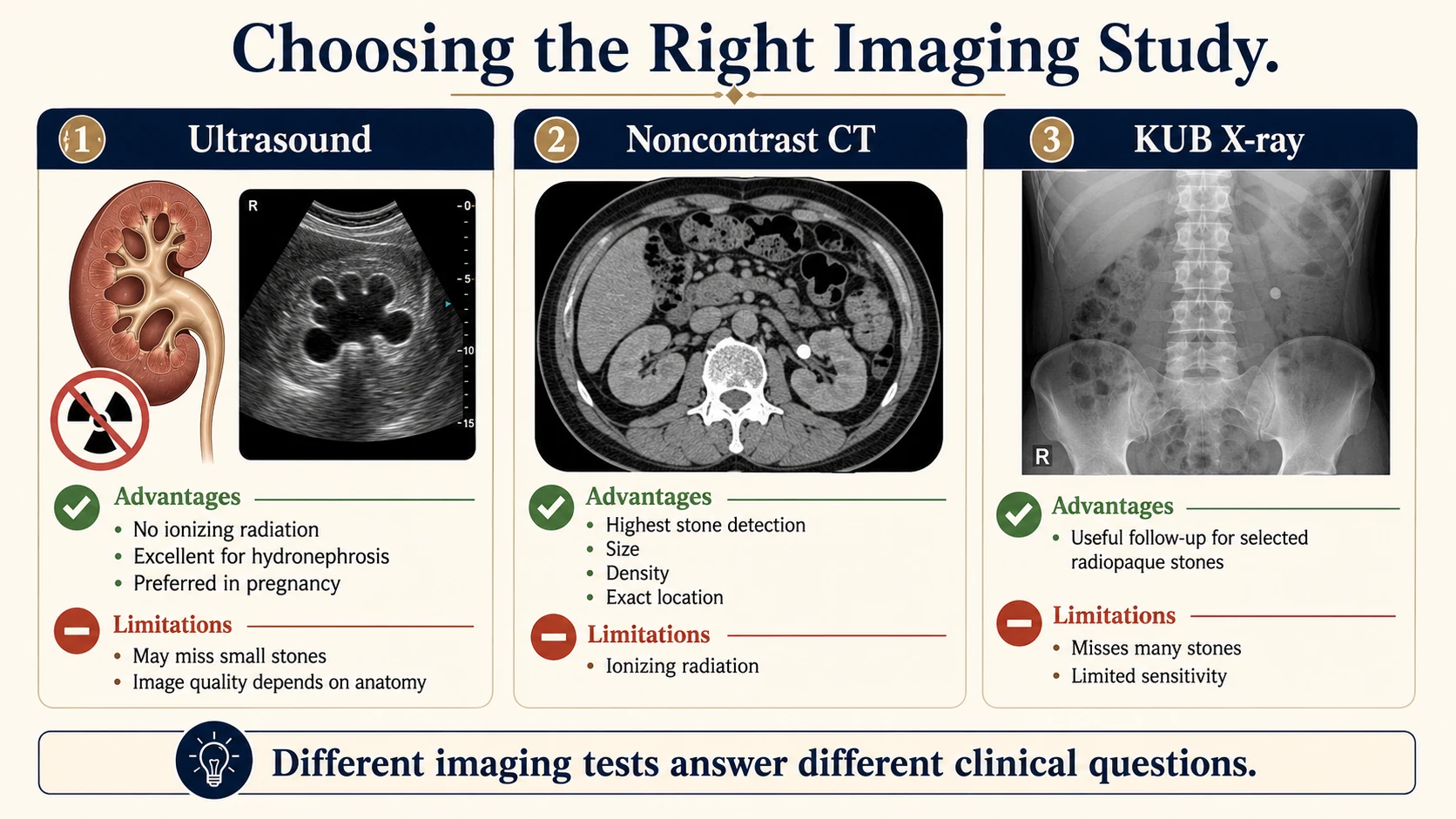
In-office ultrasound can look for kidney stones and swelling related to drainage problems without ionizing radiation. It may not show every stone, especially a ureteral stone. When the finding is uncertain or more detail is needed, CT may clarify size and location. No imaging method gives a universal guarantee of perfect detection.
Compare the whole picture
Bring previous scans and reports. We look at whether a stone has changed, whether the kidney is swollen, and whether the current findings fit your symptoms. A report saying “stone” is less useful than a documented size, location and comparison with earlier imaging. Repeat CT is not automatically necessary at every visit; the plan should answer a specific question.
Separate an active episode from long-term surveillance
A suspected unresolved ureteral blockage may need follow-up much sooner than routine surveillance. For selected patients with a history of stones, our practice may recommend ultrasound every six to twelve months. The interval depends on findings, recurrence risk and kidney health. The plan should state when to return and which new symptoms should prompt an earlier call.
Your next steps
- Keep a dated list of scans and where they were performed.
- Ask what the next scan is meant to confirm.
- Write down your individual follow-up interval.
Keep exploring
Book and sources
Adapted from Stones Unlocked by David Shusterman, MD. Treatment and prevention are individualized.