
First, close the current episode
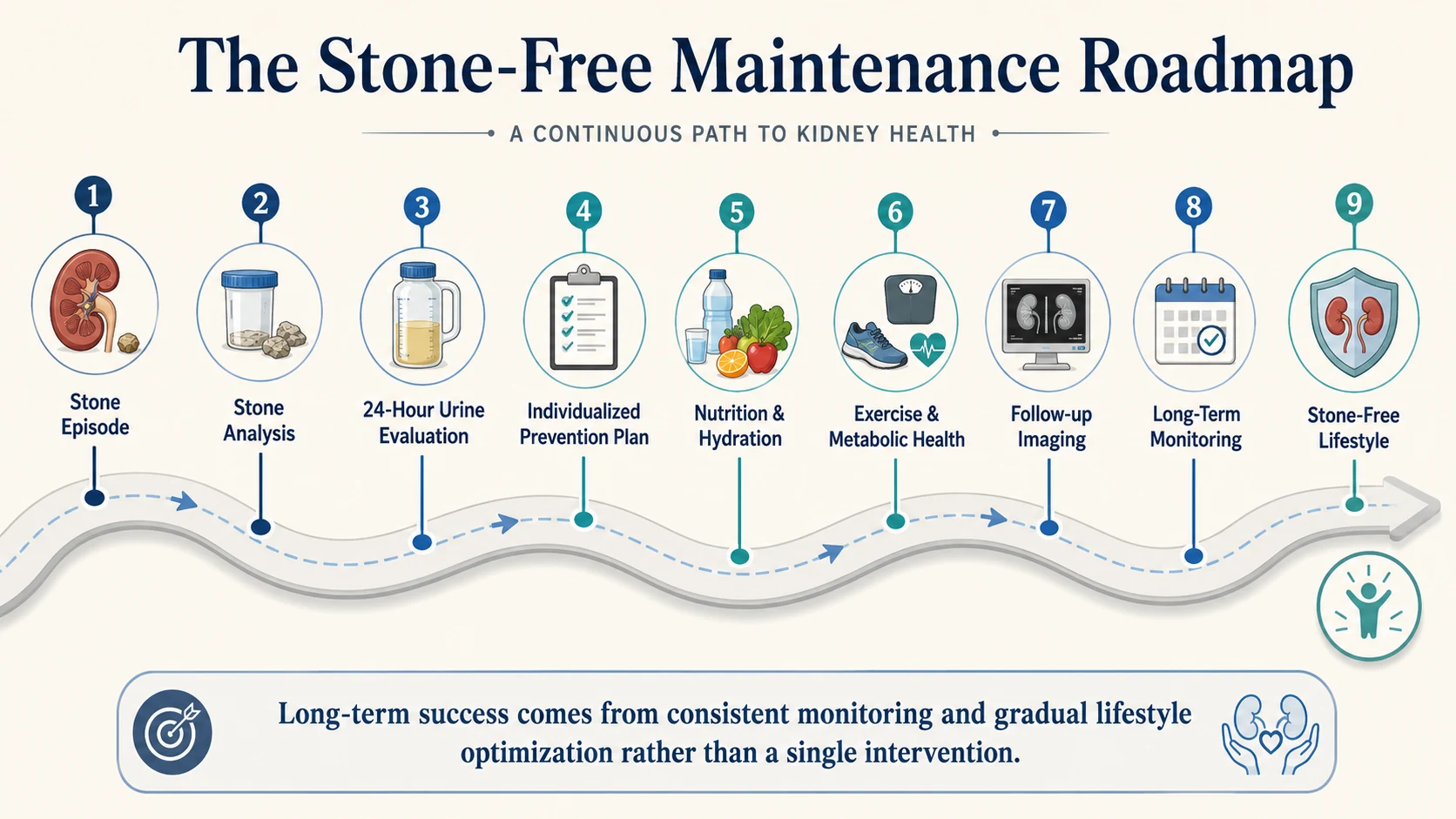
Confirm what happened to the stone and whether the kidney is draining. The evidence may include a recovered stone, your symptom course and appropriate follow-up imaging. After ESWL, fragments may remain or pass over time. Feeling better alone is not the same as confirming clearance, particularly after a ureteral stone.
Next, understand why stones formed
Review stone analysis when available, previous episodes and the findings that suggest higher risk. Selected patients benefit from blood tests and a 24-hour urine collection. We use that information to choose a prevention plan with specific food, fluid or medication decisions. The goal is an achievable plan with a reason behind each step.
Then, check whether the plan is working
Agree on the next visit, what will be measured and when imaging is appropriate. Selected patients in our practice may have ultrasound every six to twelve months for surveillance; active obstruction or a change in symptoms may require earlier assessment. Keep copies of results and bring new medication or health changes to the next review. Prevention lowers risk; it does not guarantee that another stone will never form.
Leave the visit with three written decisions
Record what is still being checked, the next action and the review date. For example, the next action may be follow-up imaging, a laboratory collection or a dietary change tied to a result. Ask who will contact you about results and whom to call if symptoms change. This turns prevention from general advice into a plan you can follow.
Adjust the calendar to the current problem
Our practice may use ultrasound every six to twelve months for selected patients with a stone history. That is a surveillance approach, not a rule for every patient. A current ureteral stone, uncertain drainage or changing symptoms can require an earlier check. Your clinician chooses the imaging interval and whether urine testing should be repeated after prevention changes.
Build the prevention plan around your results
Adapted from Stones Unlocked by David Shusterman, MD.
“Stone-free” needs a definition
Ask whether follow-up established normal drainage, whether any stone material remains, and which study was used. Ultrasound, an X-ray and CT do not detect exactly the same things. A small residual fragment is still stone material; its location, stability, composition and your symptoms determine whether observation or another treatment is appropriate. A later stone may be new formation, growth of a retained fragment or migration of existing material. Copies of operative reports, stone analysis and follow-up imaging make that distinction easier. Feeling better and complete clearance are different findings, and both deserve a clear conversation.
A useful urine collection reflects ordinary life
Follow the laboratory’s start, stop and storage instructions, and report any missed collection. Do not stage an unusually perfect diet or force extra water just for the test. An incomplete or atypical sample can lead to misleading targets. Your clinician reviews collection adequacy alongside volume, calcium, oxalate, citrate, sodium, uric acid, pH and other reported measures. Supersaturation combines several chemical factors; it is a model of the urine environment, not a direct image of a growing stone. More than one collection may be useful. Blood tests, medications, bowel conditions and stone composition help explain the pattern.
Give each change a measurable purpose
Low urine volume may call for a workable drinking routine; a high sodium burden calls for attention to portions, restaurant meals and packaged foods. Many calcium-stone formers need normal food calcium with meals, not blanket restriction. Oxalate advice should reflect the urine findings and food pattern. Low citrate or a particular stone type may prompt discussion of prescription prevention, with kidney function and blood monitoring taken into account. Medicines are not interchangeable and should not be borrowed from another stone former. Agree on what will be repeated after changes and what result would make the clinician revise the plan.
Keep a stone record that survives the next episode
Keep a short record of stone dates, procedures, composition, urine results, current medicines and the next follow-up. Tell the team about a solitary kidney, chronic kidney disease, recurrent infection, young onset, strong family history or prior bowel surgery. These details can change the investigation and follow-up intensity. Before travel, review the stability of known stones, carry relevant records and identify how to obtain care if symptoms return. A prevention routine should be achievable through workdays, exercise and hot weather. Bring practical barriers to the visit so the plan can be adjusted instead of abandoned.
Explore the visual stone guide · Reader companion and printable tools
Your next steps
- Confirm passage or treatment progress.
- Review composition and selected risk testing.
- Choose changes, set a review date and monitor according to your risk.
Keep exploring
Book and sources
Adapted from Stones Unlocked by David Shusterman, MD. Treatment and prevention are individualized.