
A small specimen can provide useful information
If you recover a stone or fragments, analysis may help identify their composition. Even a small piece can be worth discussing with the office. The laboratory result can connect the current episode with a prevention strategy. It does not replace evaluation of symptoms or imaging when drainage remains uncertain.
Follow the office’s collection instructions
Ask whether a urine strainer is appropriate and how to store and deliver a specimen. Use the container and handling instructions provided by the office or laboratory. Do not put a stone into household chemicals or a preservative unless specifically instructed. Labeling the date and recording whether it passed spontaneously or followed treatment helps keep the record clear.
Review the result instead of just filing it
Ask what the material was, whether it is mixed, and whether it changes testing or dietary advice. Bring prior reports for comparison. If no stone was caught, we can still evaluate risk through history, imaging and selected testing. Do not delay urgent medical care or assume that recovering one fragment proves that every stone has cleared.
What to bring with the specimen
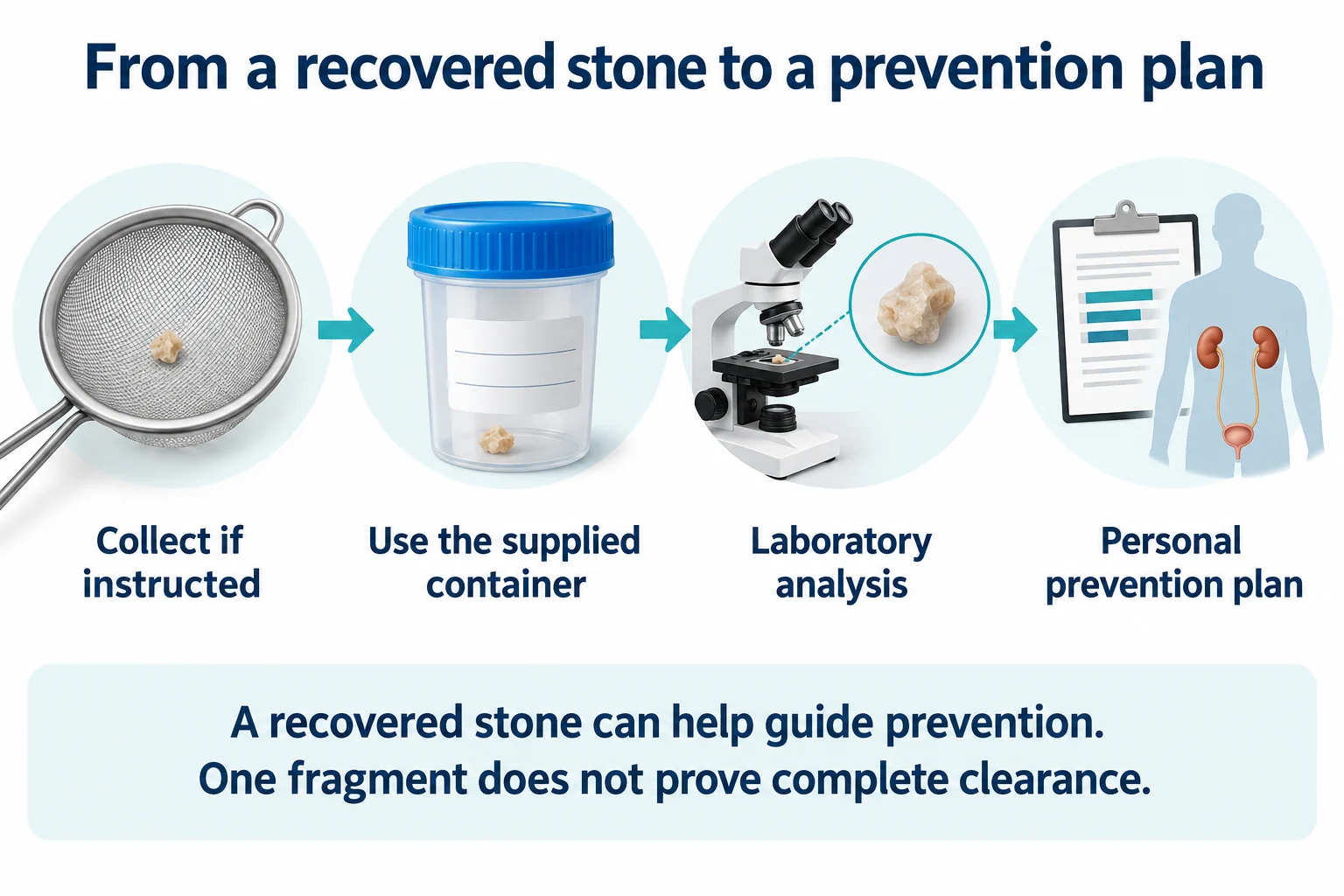
Ask the office for a suitable container and handling instructions. Record the collection date and whether the stone passed naturally or followed ESWL. Bring earlier stone-analysis reports as well. The laboratory may identify several components in one specimen, so a result can be more useful than the stone’s color, shape or hardness.
Analysis and clearance answer different questions
Analysis asks what the recovered material contains. Follow-up asks whether the current episode has resolved and whether the kidney is draining. Catching a fragment is helpful, but other fragments or stones can remain. Keep the scheduled follow-up even when you have a specimen, and ask which food, fluid or testing decision changes because of the result.
Your next steps
- Ask for collection and delivery instructions.
- Keep the specimen date with the report.
- Discuss how the result changes your prevention plan.
Keep exploring
Book and sources
Adapted from Stones Unlocked by David Shusterman, MD. Treatment and prevention are individualized.